Your Body Runs on Sunlight
Your circadian rhythm is a roughly 24-hour internal clock that governs when you feel awake, when you feel sleepy, and when your body releases hormones like cortisol and melatonin. The primary signal that sets this clock is light — specifically, sunlight hitting your eyes in the morning. This is well-established biology, not a wellness trend.
When your wake time aligns with sunrise, you get bright natural light at exactly the moment your body expects it. Cortisol rises on schedule. Melatonin clears on schedule. You feel alert faster and sleep better that night. This is how human biology worked for the several hundred thousand years before the alarm clock was invented.
Why Fixed-Time Alarms Fight Your Biology
A fixed alarm at 6:30 AM makes no distinction between June and December. But sunrise does. In most mid-latitude locations — think New York, London, Berlin, Tokyo — sunrise shifts by roughly two hours across the year. In June, 6:30 AM is well after sunrise and your body is already coming online. In December, 6:30 AM is an hour before sunrise and you're fighting your biology to get out of bed in the dark.
This mismatch is the core problem. Your alarm stays fixed. Sunrise doesn't — it drifts a few more minutes every week, and your body notices even if you don't. The Monday-morning grogginess that gets worse through autumn, the effortless early rising in summer — that's not motivation. That's circadian alignment, or the lack of it.
How Risetime Aligns Your Alarm with the Sun
Risetime lets you set an alarm relative to sunrise. Tell it "at sunrise" or "15 minutes before sunrise" and it recalculates the exact alarm time for your location every day. As sunrise drifts through the seasons, your alarm follows. You set it once.
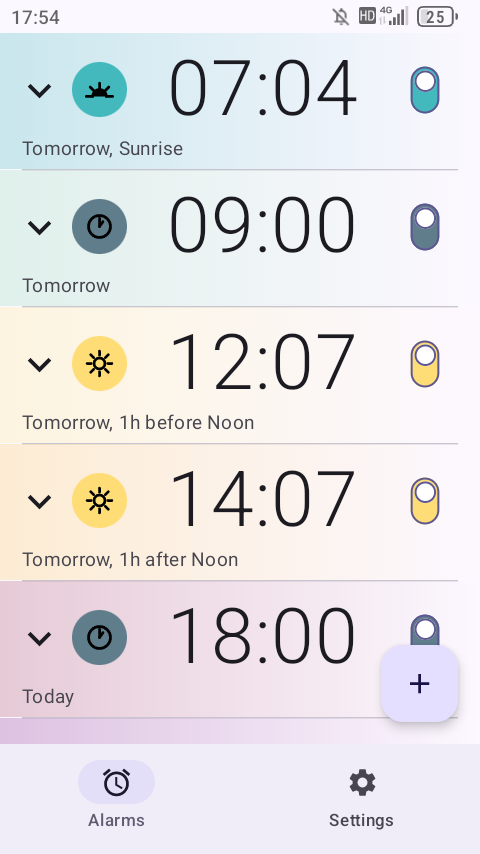
In summer, you wake earlier with the longer days. In winter, you wake later with the shorter ones. Your wake time tracks the natural light cycle the way your body expects it to. No manual adjustments, no checking sunrise tables, no resetting your alarm every few weeks.
Risetime recalculates your alarm time automatically every day in the background. Most days, you never open the app. That's by design — it works best when you forget it exists.
You're not limited to waking exactly at sunrise, either. Many people prefer a small offset — 15 or 30 minutes before sunrise — so they're awake and moving by the time the sun appears. Others prefer 15 minutes after, especially in winter when sunrise itself is the cue to get up. The offset stays fixed while the sunrise time shifts.
Advanced: A Wind-Down Alarm That Tracks the Sun
Circadian alignment isn't just about mornings. When you go to sleep matters as much as when you wake up. And if your wake time shifts with the seasons, your bedtime should too.
Here's a technique that works well: set a second alarm 8 hours before sunrise as a wind-down reminder. This gives you a consistent sleep window that shifts naturally with the light cycle. In summer, when sunrise is at 5:30 AM, your wind-down alarm fires at 9:30 PM. In winter, when sunrise is at 7:15 AM, it fires at 11:15 PM. Both alarms shift together, keeping your sleep duration constant while your schedule tracks the sun.
In Risetime, this is just another alarm:
- Anchor: Sunrise
- Offset: 8 hours before
- Repeat: Every day
That's it. You now have a wake alarm and a wind-down alarm that both move with the sun and stay exactly 8 hours apart. Adjust the offset to match your actual sleep need — 7 hours, 9 hours, whatever works for your body.
An Alarm, Not a Sleep Tracker
Most "circadian rhythm" and "biohacking" apps want access to your data. They want to track your sleep, monitor your screen time, sync to a cloud account, and build a profile of your habits. Some of them are useful. All of them are collecting data about when you sleep and wake.
Risetime does none of this. It's an alarm clock. It doesn't track your sleep. It doesn't monitor when you dismiss your alarm. It doesn't have an account system, a cloud sync feature, or an analytics SDK. It doesn't even have internet permission — it can't send data anywhere because the operating system won't let it connect.
No sleep tracking. No data collection. No accounts. No internet permission. Just an alarm that follows the sun.
Read the full privacy policy — it's short.
Your location is used for one thing: calculating where the sun will be tomorrow. That calculation happens on your phone using an embedded astronomical engine. Your coordinates are stored locally and never transmitted. There is no server.
Getting Started
Setting up a circadian rhythm alarm takes about two minutes. Set your location, create a sunrise alarm, choose an offset if you want one, and pick your repeat days. Risetime handles the rest. For a full walkthrough, see the setup guide.
Risetime is not a sleep optimisation platform. It's not a biohacking dashboard. It's an alarm clock that wakes you with the sun. If that's what you need, it does it well.